Something Nanny taught me
If, eighteen years ago, I could have looked into the future and seen myself writing about stories and empathy as serious instruments of organisational intelligence, I’d have been surprised. At the time I was running a strategic digital marketing agency, where the creative director and copywriters did all of that “story stuff.”
Then one day, something changed.
I was learning to be a parent to Naia, three, Eden, two, and newborn Devon. They loved storytime, especially when visiting their ninety-five-year-old great-grandmother in her magical living room, full of musical boxes, photographs of the olden days, and the wonderful smell of honey sweets.
One morning, disaster. They rushed in shouting “Story, Nanny!” and I realised, to my horror, that I had forgotten the storybook. I looked down at their expectant faces and felt like the worst parent in the world.
Nanny leaned over and touched my arm, exactly as she had so often when I was a child.
“Craig, no need to worry. It’ll be fine.” She turned to them. “Today, I’ve a special treat for you. We’re going to imagine a story together.”
And they did. In minutes she was helping them conjure Princess Wendy out of thin air, sending her on adventures that ended with the bad knights falling into a lake full of horse poo. “And how do you think the bad knights smelt?” she asked them, and Naia and Eden immediately held their noses and screwed up their faces in disgust.
“Where did you learn to do that?” I asked her.
“I didn’t,” she said. “When I was growing up, and she was born in 1913, we got one book a year, at Christmas. No radio. No television. So we made stories up together. You can too.”
As I started to protest that I wasn’t a storyteller, she leaned over again and said gently, “You know. They know. We all do.”
By then Naia, who had been waiting a whole minute, was tugging at my sleeve. “Another story, another story! And YOU choose the problem this time, Daddy!”
The problem. At three years old, without knowing how to read, Naia had just articulated one of the few things I actually knew about stories, which is that they all need a conflict. She had learned it from listening, and from making one up with her great-grandmother.
It hit me that stories weren’t something we bought in books or watched in films. They were something deep within us, something we don’t really learn, because it’s already part of us. Something Nanny, born before the First World War, shared with Naia, born ninety years later, without a single word of instruction passing between them.

What I kept noticing
That morning set me off on a question that’s been with me ever since. If human beings are this good at stories without trying, what else are they good at without realising?
Over the eighteen years since, I’ve spent much of my time working with organisations on storytelling, empathy, and how people make sense of complex change. Again and again, I’ve come to the same conclusion. Organisations are full of formidable human intelligence. Their leaders know it’s there. They know it’s vital. They just can’t quite get hold of it.
The strategy partner who reads a new client brief and knows, within five minutes, which of the three obvious angles is wrong, and why. The agency founder who can tell when a creative route is about to go cold, long before anyone else senses it. The clinician who walks onto a ward and picks up, in the way a junior colleague stands, that something isn’t right with a patient three beds away.
This kind of intelligence is everywhere. It sits quietly, in people, in moments, in conversations that happen and are gone. And for as long as I’ve been doing this work, the same question has followed me around.
How do you make it visible? How do you make it available, to newer people, to other teams, to the organisation as a whole, without flattening it into a process document that loses everything that made it valuable in the first place?
The layer almost everyone has been missing
Organisations have tried to answer this for decades. Wikis. Knowledge bases. Training programmes. Handover documents. Exit interviews. Most of these approaches work on what you might call the facts-and-process layer, the explicit, organised, procedural stuff that can be written down without much loss.
That layer matters. It’s useful. But it isn’t where judgment lives.
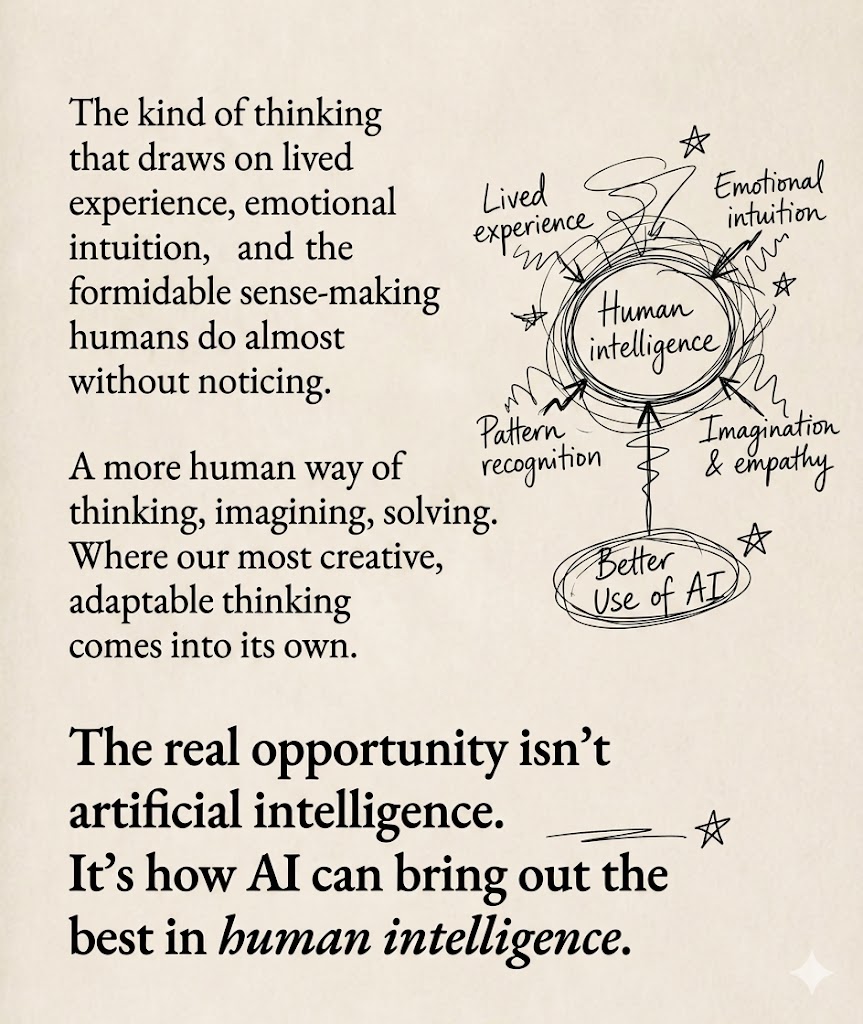
Judgment lives in a different layer, the one made of lived experience, emotional intuition, and pattern recognition built up over years. The layer where stories naturally sit. It’s the layer Nanny was operating on when she improvised Princess Wendy out of nothing. It’s the layer Naia was already using when she knew, at three, that stories need a problem. It’s the layer your best people are using when they make the judgment call that the data alone couldn’t have told them to make.
Most knowledge systems have been missing this layer. Not because anyone thought it didn’t matter, but because nothing existed that could work with it. You can’t easily index intuition. You can’t put emotional intelligence in a spreadsheet. You can’t turn a story into a bullet point without destroying what made it a story.
Until now.
The eureka, when it came, was almost embarrassingly ordinary
I was writing a workshop about storytelling. Stuck, as you sometimes are, reaching for an analogy that would help people grasp why stories work the way they do. I put the notes down and went to make a cup of tea.
And the phrase arrived, unbidden. Stories are our operating system.
Not the apps. Not the content. The underlying software that lets everything else run. The way human beings have always packaged judgment, emotion, memory, and meaning into a form that travels intact between people.
Immediately, the next thought came. If that’s what stories are, if they really are the operating system of human sense-making, then with the AI tools now available, can we decode them? Can we find the patterns? Can we build something that works with this layer in the way existing knowledge systems work with the facts layer?
I don’t imagine myself in the company of Newton, Archimedes or Darwin. But I think, for the first time, I can empathise with the moment they describe, when something that had been sitting quietly in the background suddenly rearranges itself into a pattern.
Why now
What makes this moment different isn’t any single breakthrough. It’s a convergence.
The tools have arrived. AI systems can finally work with narrative in something close to its native form, not as data to be counted, but as meaning to be understood.
The infrastructure is already there. Most organisations are already in Teams, SharePoint and Zoom. The raw material of their thinking is already being captured. It’s just not being made sense of.
The culture is ready. After thirty years of digital transformation, people are used to new ways of working. They’re also, rightly, sceptical of hype, which makes them more receptive to something that actually uses technology to support human judgment rather than replace it.
And the foundations have been waiting all along. Aristotle noticed, twenty-three centuries ago, that every story has a beginning, middle and end. Joseph Campbell mapped the hero’s journey across cultures separated by oceans and millennia. Paul Zak has shown, more recently, exactly what happens in the brain when a good story is told, which hormones release, which regions activate, why we trust what we trust. The science of story and empathy has been accumulating quietly for a very long time. It just didn’t have a partner until now.
The opportunity, plainly
If stories are the operating system of human sense-making, and if AI can finally work with that operating system rather than around it, then something becomes possible that wasn’t possible before. Organisations can, for the first time, amplify their human intelligence layer in the same way they’ve spent the last two decades amplifying their data and process layer.
Not replacing it. Not substituting AI for human judgment. Amplifying the judgment itself, making it more visible, more generously available, more alive to change.
That’s the work ahead.
Before I come to the work itself, a word about what I’ve been thinking about
If you’re thinking seriously about any of this, there’s a reasonable chance you’re also thinking about the things that could go wrong. I’d be surprised if you weren’t. I’ve been thinking about them too.
Some of it is the obvious stuff. AI makes people anxious, for reasons that are real and deserve respect. Being asked to talk openly about how you work, or how you’ve handled difficult situations, is uncomfortable for good reasons. Confidentiality and governance can’t be an afterthought. The quality of the thinking that goes into an AI system matters more than the technology, because AI is an amplifier of whatever you feed it, and it amplifies poor thinking as reliably as it amplifies good thinking.
Some of it is subtler. The human layer of an organisation, the storytelling culture, the empathy, the trust, cannot be fixed by AI. If that layer is weak, AI will deepen the weakness rather than repair it. Work like this has to begin with the culture, not the technology. It also has to be led from the top, not because of authority but because of signal. If leaders aren’t visibly engaged with what the organisation is learning about itself, the rest of the organisation won’t engage either.
And some of it is simply a matter of time horizon. An AI capability of this kind is not a project that finishes. It’s a new way of working that lives in the organisation and needs tending, the way any living thing does. The work is deliberately designed to be absorbed gradually, with the organisation taking more ownership of it over time, rather than creating a dependency on any one person or tool.
None of these concerns are reasons not to do the work. They are reasons to do it carefully, and in the right sequence.
The right sequence
The way this work gets delivered should itself be an example of what it’s meant to build. Stories and empathy aren’t only what we’re trying to amplify in the organisation. They’re how the Narrative Intelligence Methodology does the amplifying.
The methodology has four layers. Each layer enables the next. Each layer deepens what came before. None of them has a finish line.

Layer 1. Cultural Foundation — Storytelling and Empathy
This is where the work lays firm storytelling and empathy foundations across the organisation. On their own, these foundations are engaging, inspiring, often fun, and valuable in everyone’s day-to-day work. They justify themselves without needing to be part of a broader AI project. The reason they sit here, at the start, is that they’re the cultural precondition for everything that follows.
People move from “that’s not me, I’m not a storyteller” to “actually, I do this all the time, and now I have permission to use it as part of how I work.” For most people, there’s relief, and often some enjoyment. The confidence that builds in those first few weeks is what makes the rest of the work possible.
Three things run alongside each other to make this layer work.
First, live sessions. Workshops designed to be energising, practical, and specific to the organisation’s own context. These are the set-piece events that build confidence quickly and give people something memorable to refer back to.
Second, virtual learning modules. Short, structured, available when people need them, designed to extend the energy of the live sessions into the weeks that follow rather than letting it dissipate.
Third, and this is where AI joins the work from day one, the Narrative Coach. A storytelling and empathy agent, available to everyone, on tap, through the tools they already use. The Coach sits alongside people as they prepare for meetings, shape presentations, draft difficult messages, or think through a conversation they’re about to have. It offers contextual suggestions, drawing on a library of storytelling and empathy tools developed for the practice, and tuned to the organisation’s own style and context.
The Narrative Coach matters in practice, but strategically too. It lowers the anxiety most people feel about AI by introducing it through small, helpful moments rather than through a major capability launch. It starts the value exchange principle from the first week. And, quietly, it begins to seed the material that will become the Listening Layer later in the methodology. When someone uploads a document for the Coach to work with, or asks it a question about a specific situation, the organisation starts to notice patterns in how its people actually work.
Alongside the human programme and the Narrative Coach, this is where the technical foundations begin. An audit of the organisation’s existing storytelling and empathy culture, to understand the starting point. An early scoping of what the Narrative Mentor will need to do, and how it will fit with whatever knowledge infrastructure is already in place. The narrative cues that distinguish judgment in this particular organisation, the decision moments, the language people use, the patterns that matter here and nowhere else, start to be identified.

Layer 2. Narrative Discovery
This is the layer where the story and empathy methodology is used to draw out what’s been invisible. The remarkable judgment, pattern recognition, and intuition that the organisation’s most experienced people carry, but cannot easily articulate.
How? Through conversations. Not interviews, not questionnaires, not extraction.
These are structured conversations, drawing on research-based methods such as narrative inquiry and cognitive task analysis. Both are well-established ways of helping experienced practitioners surface what they know by revisiting moments rather than processes. Stories, in other words, because stories are how this kind of intelligence naturally travels.
These conversations can be led by an Imagine More facilitator, or by someone inside the organisation who is trained to do it. The second is almost always better for the long term. A core principle of the work is that capability should live inside the organisation, not in a consultant who keeps needing to be called back. The person doing the listening matters more than most people realise, and that person should, over time, be one of yours.
Technically, this is where the structured story material is captured in a form the Narrative Mentor can eventually work with. The tagging framework, the decision types, contexts and outcomes, and the themes, are developed here, because they have to reflect how this specific organisation actually thinks.
Layer 3. The Listening Layer
Deliberate story-capture is powerful but limited. It reaches the people the programme reaches. Alongside it, a quieter, ongoing layer begins to form, drawing on the everyday life of the organisation: meetings, decisions, discussions that are already being recorded and would otherwise be forgotten. Over weeks and months, patterns begin to emerge that the organisation can’t see in real time.
The Listening Layer only works on one principle, and it’s worth stating plainly. People will only agree to have their work contribute to something like this if they see personal value from it quickly. Not abstract organisational value. Not future payoff. Personal value: better work, time saved, less friction, something that makes the next meeting or the next decision easier. Within minutes, hours, or at most days. This is fundamental to the design of the whole programme. Without it, nothing else holds.
The Listening Layer isn’t surveillance. It’s more like a reflective surface the organisation holds up to itself from time to time, to notice things it couldn’t otherwise notice. It works because the culture work has come first, and because the value exchange is real.
Technically, this is where the Narrative Mentor starts to have something rich to work with. The everyday narrative material, tagged and indexed against the framework developed in Layer 2, starts to become a living resource. A long-context AI model like Claude runs batch analyses to extract patterns, flag themes, and prepare the material for the Sense Layer that follows.
Layer 4. The Sense Layer
The Narrative Mentor is the deeper, more specialised counterpart to the Narrative Coach that’s been running since Layer 1. Where the Coach supports everyday storytelling and empathy, the Mentor holds the organisation’s own accumulated judgment, its captured stories, its recognised patterns, the texture of how it actually thinks.
What the Narrative Mentor actually is: an AI presence grounded in the organisation’s own stories and collective judgment, available to anyone who wants to think something through.
Not a replacement for senior people. Something more like their accumulated wisdom, made available to everyone.
For the strategy partner from earlier, the one who reads a brief and knows which angle is wrong, the Mentor means that instinct, and the hundred other instincts of colleagues past and present, is available to the junior consultant working late on a proposal. For the agency founder who senses a creative route going cold, the Mentor means that sense is built into how the team works, not lost when the founder is in another meeting. For the clinician who reads a ward environment at a glance, the Mentor means that kind of pattern-reading isn’t dependent on one person being in the right place at the right time.
Technically, the Narrative Mentor lives within the organisation’s existing infrastructure. For most clients that means a Copilot Studio agent built on Microsoft’s stack, working with SharePoint, Teams, and the other tools the organisation already uses. This isn’t a new platform to buy. It’s a capability added to what’s already in place.
What holds the four layers together
None of this is a sequence you finish and put on a shelf. The Cultural Foundation keeps needing tending. New stories keep needing gathering. The Listening Layer keeps offering new patterns. The Narrative Mentor keeps needing updating as the organisation changes.
The Narrative Intelligence Methodology is a programme, not an advisory engagement. What clients receive is a structured approach, supported by AI tools and templates, delivered alongside the organisation’s own people rather than done to them. The intensive period at the start gives way to a lighter, ongoing relationship as the organisation absorbs more of the capability into itself. The goal, if the work goes well, is for Imagine More to be needed less rather than more.
About Craig Hill
Steve Jobs famously “joined the dots” of his astonishing career retrospectively. It’s probably the only parallel I’ll ever claim with him, so I’ll grab it. I find myself joining my own dots in the same way, not able to see any point where what I did then was part of a plan, but it all makes sense now. Particularly now, where AI has thrown an unexpected new dot into the picture.
I spent the first part of my working life in and around digital transformation, in a very hands-on way. After shedding my business training wheels in the entrepreneurial Silicon Valley culture of the early 1990s, I founded and led two international digital strategy agencies over a fifteen-year period. Both were self-funded and grew to over £5m profitable turnover, one scaling from a solo start-up to around 140 people in six years, the other to 100+ people with international offices.
In 2006, one of them was independently assessed at the level of the top five companies to work for in the UK, as listed by The Sunday Times. I’m proud of that one in particular, because it was a direct consequence of something I’d come to believe quite strongly: that the health of the human layer of an organisation and the quality of what it produced were not separate things.
In 2013, wanting to play a more active role in raising my three children, I stepped away from executive leadership and began working independently. At first I thought I was taking a quieter path. Instead, the questions I’d been carrying from my agency years, about how culture actually works, about what makes people trust each other enough to produce their best thinking, about why some organisations can adapt to rapid change and others can’t, moved to the centre of my work. A fascination with neuroscience and psychology gave a specific lens to that focus.
Since then, I’ve spent more than a decade working at the intersection of strategy, storytelling, empathy and organisational culture. My clients have included Bayer, LEGO, the BBC, and Future Media Plc, among others, often during periods of significant change. Most of that work has been about the same thing in different forms: helping people and organisations make sense of complex situations emotionally as well as intellectually, and helping them do that together.
I’m a co-founder and Director of EmpathyLab, a not-for-profit that uses stories to build children’s empathy skills, working with authors, schools, researchers at the University of Sussex, and national education initiatives. In parallel, I’ve helped develop The Joy of Creativity, a play-based initiative exploring how imagination and emotional intelligence can be cultivated in organisations under pressure. Both of these have been teachers as much as they’ve been work.
The thing I hadn’t expected is how well all of this would turn out to have prepared me for the moment we’re now in. Running businesses that had to reinvent themselves almost yearly taught me what works and what doesn’t when organisations face constant change. The pivot into behavioural and empathy-led work gave me the lens for thinking about collective human intelligence as something real, something you can actually work with, rather than something abstract. And the long, patient work on storytelling, both with children and with senior leaders, has left me with a particular conviction: that stories aren’t a communication technique but the operating system of how humans think.
When agent-based AI arrived, something that had been in the background for years suddenly had a partner. The formidable human intelligence I’d been watching in organisations, the kind that sits quietly in people and conversations and gets lost as the organisation changes, could now be worked with at scale, in a form that preserved rather than flattened what made it valuable.
Imagine More is where all of this becomes practice. Tangible projects that test the thinking against the real world, because thinking alone isn’t enough. It has to be useful. A simple litmus test for each is that it delivers something valuable to the audience it serves: families, business, schools. And on a more personal note, I hope it makes a small contribution to the broader conversation about “where next” for our planet and its many and varied occupants.
If this has struck a chord, I’d be very happy to explore it with you.